Online schools have grown rapidly over the last decades. Especially during the pandemic they played a crucial role in ensuring that thousands of learners could continue with their education from home. The state had little choice but to allow these online schools to offer their services, since the physical schools were closed. After the pandemic the growth of online schools continued.
For families who rely on online education, this raises an important question: are parents allowed to make use of online schools, or could they unknowingly fall outside the requirements of South Africa’s education laws?
The uncertainty arises because South Africa’s education laws were written at a time when schooling almost always took place in physical classrooms. Online education does not fit neatly into this framework. As a result, the legal system struggles to determine how online schools should be regulated. Online schools are not illegal, but they are not recognised either.
The Constitution
Section 29(3) of the South African Constitution recognises the right to establish independent educational institutions. It states : "Everyone has the right to establish and maintain, at their own expense, independent educational institutions that- (a) do not discriminate on the basis of race; (b) are registered with the state; and (c) maintain standards that are not inferior to standards at comparable public educational institutions." Given this one would expect that online schools must be registered with the state and their standards monitored.
The SA Schools Act
S46(4) of the South African Schools Act states that "No person may establish or maintain an independent school unless it is registered by the Head of Department." In South Africa, education is funded by the national department and administered by the provincial department. This means the online schools must be registered by the provincial Head of Department. However, the learners and teachers of online schools are not limited to one province. They are not even limited to South Africa. Without clarity on where online schools must register, this is difficult.
Provincial Regulations
Let’s say an online school limits its operations to the Western Cape, and wants to register in terms of the regulations on independent school in the province. The list below gives a number of requirements it must meet:
- S2(1)(c) of the Western Cape regulations require the "The school buildings and grounds must offer the space, design and facilities which conform to standards ...".
- Furthermore S2(2)(c) requires that "The Head of Department must determine the maximum number of learners who may be admitted to such an independent school on the basis of the school buildings and grounds referred to in subregulation ...".
- Independent schools are required to "... keep a record of the registration of all employees with the South African Revenue Service and the Unemployment Insurance Fund;"
Since online schools do not use buildings to provide education, have no inherent limitation on the number of learners, and may employ staff across the world, meeting such requirements is challenging.
Accreditation with Umalusi
Independent schools must also be accredited with Umalusi. Some accreditation requirements that must be met are described in a guide published by Umalusi.
- “An Independent School must be registered with the Provincial Education Department prior to seeking accreditation with Umalusi.” The above paragraph explains why registration with the province is challenging. An online school that is not registered with a province cannot apply for accreditation with Umalusi.
- Just like provincial registration, the accreditation is linked to the premises and the capacity of the school, which is not applicable to online schools.
- “The grades for which accreditation is sought must lead to the National Senior Certificate.” This makes it difficult for online schools that offer curriculums other than the state curriculum to be accredited.
Accreditation with Umalusi will therefore be even more challenging for online schools than registration with provincial departments.
Accreditation with SACAI and IEB
Many online schools are registered with SACAI or the IEB examination boards. In turn, the examination boards are accredited with Umalusi. It must be noted that this registration only applies to the issuing of the National Senior Certificate (NSC), which is valid for Grade 10 to 12. The examination boards have their own exam centres. Learners from online schools write their exams at these centres. The boards also oversee that calculation of school based assessment scores. The registration with an examination enables the learners of online schools to obtain and NSC qualification, but does not mean that the online schools are registered.
However, online schools that offer qualifications other than the NSC, such as Cambridge or GED do not need to register with these examination boards. Schools offering Cambridge or GED often operate under different accreditation frameworks.
Are online schools legal in South Africa?
The constitution does not restrict independent educational institutions to physical schools only. Therefore online schools are not prohibited by the constitution.
Another difficulty arises from the fact that the Constitution protects the right to establish independent educational institutions without specifying how education must be delivered. Historically this took place in physical classrooms, but modern technology allows education to be delivered online. Laws that were designed for physical schools therefore struggle to accommodate new forms of education. From a constitutional perspective, regulation should focus on the educational activity itself rather than the technology used to deliver it.
The current legal framework was designed for physical schools and does not clearly accommodate online schools. If the state were to prohibit online schools entirely, it would likely conflict with the constitutional protection of independent educational institutions. There would therefore be strong grounds to challenge any attempts by the state to outlaw online schools.
Unfortunately the state seems unwilling to accommodate online schools. The BELA Bill was the first major revision of the Schools Act since 1996. When the BELA Bill was considered by parliament, there were a number of submissions, including one from the Human Rights Commission, that requested that this opportunity must be used to make provision for online schools. It would have been perfectly reasonable if parliament sent the BELA Bill back to the DBE and request the inclusion of online schools. Parliament however failed to do this, causing online schools to operate in a grey area for even longer.
Because online schools are not prohibited by the constitution, the outright prohibition would likely face constitutional challenges, but it may regulate it with appropriate regulations.
Given that parliament failed to respond to a request to regularise online schools in the BELA Bill, leaving the legal framework unclear, there is currently no explicit prohibition on parents making use of online education services.
Is an online school a school?
Some might argue that an online school should not be viewed as a school, but merely as the provider of educational resources. Such institutions do not need to register as schools.
There are however a number of reasons why this is not preferable:
- The definition of a school in the Schools Act is that it :”… enrols learners in one or more grades from grade R (Reception) to grade twelve;” If an online school enrols learners in a grade, it will be difficult to argue that it is not a school.
- It might restrict the use of online schools to parents that educate their children at home and will exclude many learning centres and small schools that provide partial care to children as well as access to online schools.
It is important that online schools are regulated in a way that provides education to the broadest group of people, and not in a way that it protects the vested interests of specific groups.
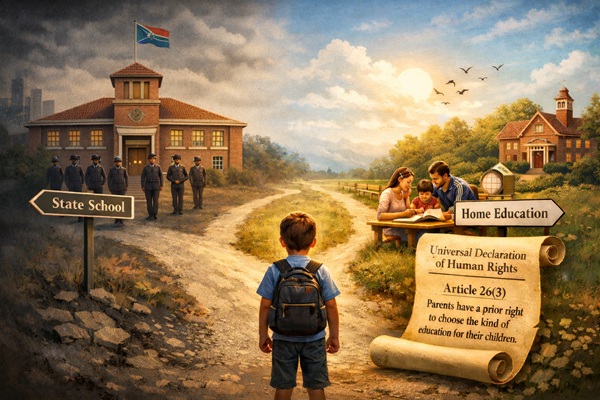
Should home learners that use online school register for home education?
Some online schools encourage parents to register learners for home education in terms of S51 of the SA Schools Act. Parents should note that registration for home education does create certain risks in this situation:
- According to S3(1) of the SA Schools Act " ... every parent must cause every learner for whom he or she is responsible to attend school ...". As explained in the previous section, it is reasonable to view an online school as a school. There is therefore a reasonable argument to claim that parents that have enrolled learners in an online school have complied with the requirement of S3(1), and do not need to register for home education. This is also in line with Section 6 of Circular S15 of 2022 by the DBE that states that "..., only applications for the registration of learners for home education, which state that the education of learner will happen primarily at their home must be accepted. This means that applications for registration of learners to attend online schools should not be accepted."
- In its definitions the SA Schools Act states that home education "... may include tutorial or other educational support, if necessary, secured by the parent on specific areas of the curriculum followed by the learner;..." This wording suggests that learners registered for home education may only make use of tutorial support in specific areas of the curriculum, rather than following a full institutional programme. If registered home learners use an online school, there is a risk that officials might regard the online school as educational support and require that the use of this is restricted to parts of the curriculum.
- It must be noted that registration for home education is only required for Grades R to 9. No registration is required for Grades 10 to 12.
The legal position is therefore unclear. Some online schools encourage parents to register for home education, while others argue that learners enrolled in online schools are already attending a form of school. Registration gives more legal certainty but could restrict parental freedom, while non-registration gives greater flexibility but less legal certainty. SAHomeschoolers provides a personal consultation service to advise parents on the risks associated with registration and non-registration in their specific situation.
The way forward
On 6 January 2026 an EFF MP asked the minister on the status of online schools and the answer was as follows: “The DBE obtained a legal opinion from OCSLA advising that the South African Schools Act, 1996 should be amended to include online schools. Work is underway to develop proposed amendments to the South African Schools Act, 1996 to include online schools, as well as interim measures to guide the sector in how best to address existing online schools.” In response to this, on 4 March 2026,SAHomeschoolers wrote to the DBE for a copy of the legal opinion and any interim measures contemplated.
On 24 March 2026, the DBE provided the following feedback on the above request:
- The DBE acknowledged that "... the South African Schools Act, 1996 (Act No. 84 of 1996), does not make explicit provision for the establishment and regulation of fully online schools."
- Legal opinions from OCSLA "... form part of internal deliberative processes and are not generally made publicly available."
- No specific dates were given for the guidelines, but the DBE encourages stakeholders to "... to continue operating within the existing legal and regulatory framework governing schooling in South Africa."
The previous sections in this article is reasonable guidance on how to operate in the existing legal and regulatory framework.
Conclusion
The rapid growth of online education has exposed a gap in South Africa’s education law. The regulatory framework governing independent schools was designed for physical institutions with buildings, classrooms and geographically defined learners. Online education does not fit this model. As a result, many online schools operate in a regulatory grey area. While the Constitution protects the right to establish independent educational institutions, the practical mechanisms for recognising online schools remain unclear. Until the law is updated, uncertainty will remain for both providers and families.
Education is based on the paradigm that the delivery of education requires dedicated physical buildings. Online schools require this paradigm to shift. This shift has already happened in the corporate sector where training has moved online. This happened quietly and quickly, because it did not require regulatory changes. However reform in the basic education sector is highly regulated by the state, which is struggling to make the paradigm shift.